

Refer to Inbound performance optimization for the Inbound Performance feature overview.
To adjust the Inbound performance optimization parameters, go to “Configuration → Inbound“.
The following configuration parameters can be adjusted:
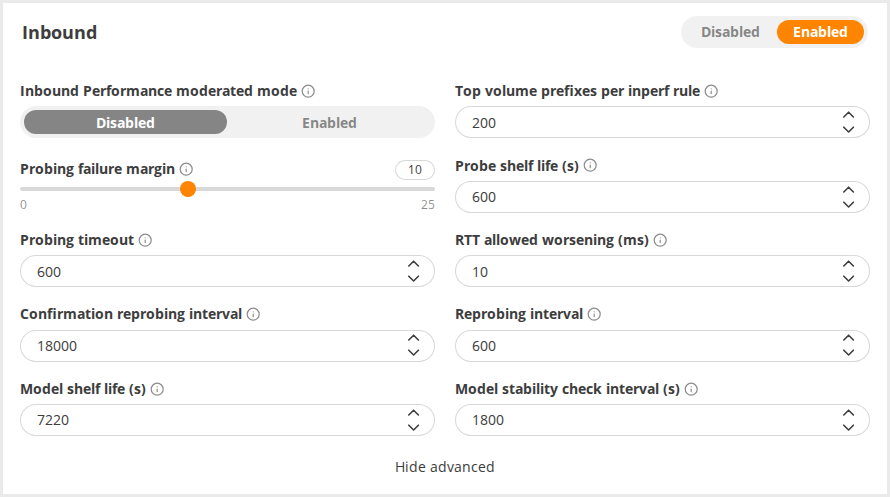
- Inbound performance (irpinperfd.enabled) enables/disables inbound performance optimization. This also disables the traffic statistics collection, required for inbound performance optimization
- Inbound Performance moderated mode (irpinperfd.moderated) enables/disables manual moderation of all decisions of the inbound performance optimization algorithm
- Probe shelf life (irpinperfd.probing.shelf_life) sets the maximum age of a probe which can be reused
- Probing failure margin (irpinperfd.probing.failure_margin) sets the percentage of probing failures (maximum possible value is 25%), exceeding which is critical and leads to the inbound performance optimization algorithm restart
- Probing timeout (irpinperfd.probing.timeout) sets the time period of probing process, exceeding which is critical and leads the inbound performance optimization algorithm restart
- Reprobing interval (irpinperfd.probing.interval) sets the period of time to wait until the algorithm starts reprobing a sample and comparing it against the model
- Top volume prefixes per inperf rule (irpinperfd.model.topn_per_rule) sets the number of prefixes to be considered for the rule’s model construction. Prefixes with greater volume are taken into account first
The Inbound Performance feature makes it’s decisions based on the configured rules.
 When the Moderated mode is enabled, the Inbound Performance improvements should be applied manually at the Inbound Performance Rules page.
Inbound Prefixes collector settings: #
→ prefix belonging to the network (inbound.rule.X.prefix),
→ router(s) where announcements are sent (inbound.rule.X.bgp_peer),
→ next hop used by improvements for this prefix (inbound.rule.X.next_hop)
→ an option to instruct IRP whether to fully control the prefix or to only announce improvements when there are any.
→ providers for which this inbound prefix can be optimized (inbound.rule.X.providers). It must be noted that if no provider is selected then the prefix is optimized for all providers. Otherwise, the prefix will be optimized only through selected providers.
→ prefix status as each prefix can be disabled in order to exclude from further inbound optimization (inbound.rule.X.enabled)
→ router(s) where announcements are sent (inbound.rule.X.bgp_peer),
→ next hop used by improvements for this prefix (inbound.rule.X.next_hop)
→ an option to instruct IRP whether to fully control the prefix or to only announce improvements when there are any.
→ providers for which this inbound prefix can be optimized (inbound.rule.X.providers). It must be noted that if no provider is selected then the prefix is optimized for all providers. Otherwise, the prefix will be optimized only through selected providers.
→ prefix status as each prefix can be disabled in order to exclude from further inbound optimization (inbound.rule.X.enabled)
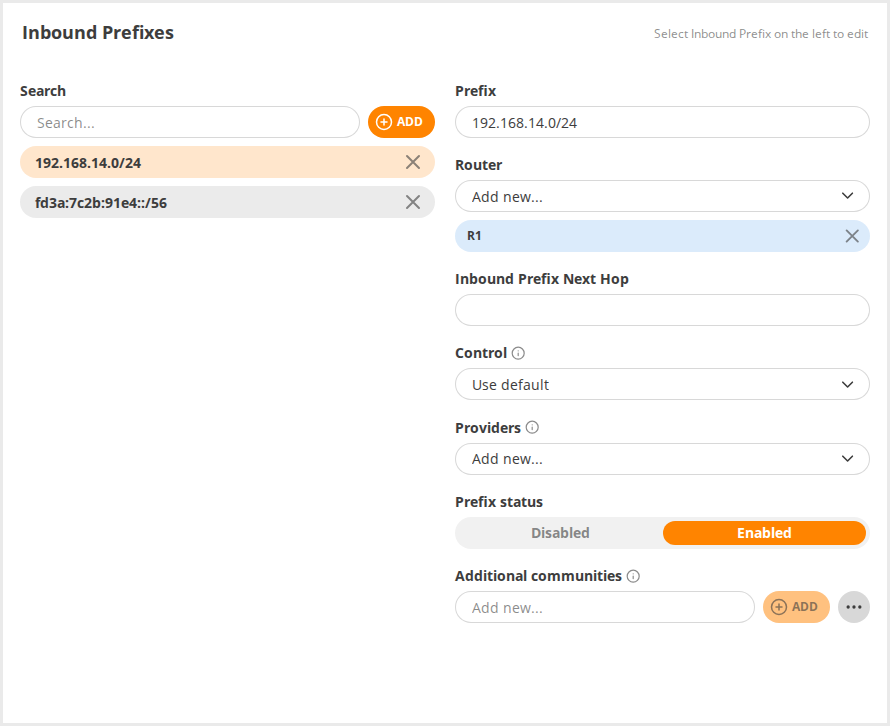
Figure 3.13.22: Configuration editor: Inbound Prefixes settings